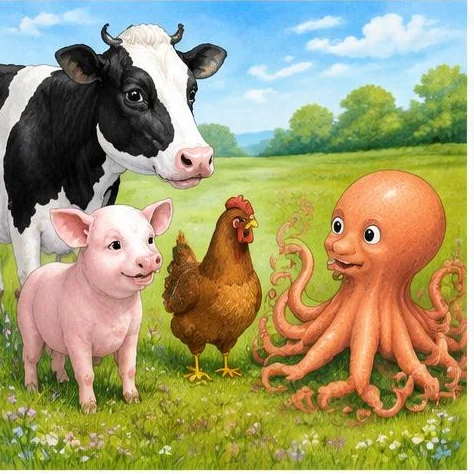
Pick an animal friend and ask them anything. Every answer is real science, told the way you like it.
🐄Hello! I'm Clara the cow. Pick a question and I'll tell you what cows are really like.
Questions you could ask
Animal questions and answers
Browse every answer, then pick a character above for an age-matched version.
🐄 Ask Clara the Cow
Do cows have best friends?
Yes! Many cows have favourite friends they like to stay close to. Being with a friend can help us feel calmer.
Can cows remember things?
I can tell more than 50 of my herd apart, and I remember the way to my favourite field for years.
How do I know when a cow is happy?
Look for leaping, a swishy relaxed tail, and ears pointing sideways instead of back.
Do cows talk to each other?
We each have our own voice. Mums and calves call to each other and know exactly who's who.
🐖 Ask Pip the Pig
Can pigs play video games?
Really! Pigs have learned to use a joystick with their snouts to move a cursor to a target and win a treat.
Do pigs know their own names?
Yes — pigs learn their names in a few weeks and come when they're called, just like dogs.
Why do pigs roll in mud?
Pigs can't sweat much, so mud cools us down and protects our skin from sunburn and bugs.
Do pigs get sad?
Yes. Pigs feel sad and hopeful, and we catch each other's moods, just like people do in a classroom.
🐔 Ask Chico the Chicken
Do chickens dream?
Chickens have the same kind of dreaming sleep that people do, so scientists think we probably dream too.
Can chickens talk?
We have around 30 different calls — including different alarms for a fox on the ground and a hawk in the sky.
Do chickens know each other?
I can recognise about 100 different faces — chicken faces and human ones.
Why do chickens roll in the dust?
Dust bathing keeps our feathers fluffy and gets rid of itchy mites. We do it together because it feels good.
🐙 Ask Ollie the Octopus
What do fish and octopuses feel?
Fish and octopuses feel pain, comfort, fear and curiosity. That's why gentle handling matters so much.
How clever is an octopus?
I can open jars, solve puzzles and squeeze through a gap only a little bigger than my beak — the only hard part of my body.
Do your arms think for themselves?
Two thirds of my brain cells live in my arms, so each arm can explore on its own while I think about something else.
How do you change colour?
My skin is packed with colour cells I can stretch and squeeze in a blink, and tiny bumps can rise to change my texture, so I blend in with lots of backgrounds.
🌱 Chat with Sprout
Ask about animals, plants and our planet. Sprout answers for your age, in your language, and shows where the facts come from.
Hi, I'm Sprout! What are you wondering about today?
Please don't type your name or where you live. Chats stay only on this device. Answers are made by a computer helper — check big questions with a grown-up.
Are the animal characters speaking their real thoughts?
No. Their voices are a storytelling device for simplified science. Real animals communicate through their own behaviour and signals. Sprout's computer-generated explanations can be mistaken, even when they list sources.
1. Make the question specific
Instead of asking whether all animals are clever, choose a species and a behaviour: how does a cow recognise a familiar cow? A focused question is easier to investigate than a ranking of intelligence.
2. Follow the evidence
Open a cited source with a grown-up. Does it discuss the same animal and the same claim? A link alone is not proof. Look for an explanation, a study or a named expert rather than a repeated slogan.
3. Know when to ask a person
Ask an adult or veterinarian about an animal that seems injured or unwell. Do not try a treatment from a generated answer. Keep names, contact details, school names and addresses out of your questions.
Your field challenge
Ages 7–9
Ask a question beginning with how or why. Say which animal you mean.